

Bringing your loved one to the UK to start a life together should be a joyful milestone. However, many couples soon find themselves overwhelmed by the complexities of UK Immigration Rules.
If you’re planning to settle here, you’ll need to choose between two main options under the Family settlement visas category: the UK Fiancé(e) Visa for marrying inside the UK or the UK Spouse Visa for marrying abroad and relocating as a husband, wife, or civil partner.
Selecting the right pathway is not just a matter of love; it’s a significant financial and logistical decision. An experienced UK immigration solicitor can guide you through the process, helping you understand the costs, requirements, and how to avoid costly refusals.
What Exactly Is the Fiancé(e) Visa?
Think of the fiancé(e) visa as a temporary bridge. It is designed specifically for people who want to marry a British citizen, someone with Indefinite Leave to Remain (ILR), Settled or Pre-settled Status, an EU national or someone in the UK with refugee status/humanitarian protection. The Home Office grants this visa for up to six months.
Its sole purpose is to let the non-UK partner enter the country legally so you can hold your wedding or civil partnership ceremony on British soil, then switch to a more permanent spouse visa within the UK.
Important Distinction: Fiancé(e) Visa vs. Marriage Visitor Visa
A common point of confusion is mistaking the Fiancé(e) visa for a Marriage Visitor Visa. If your intention is to get married in the UK and then stay and settle here permanently, you must apply for a Fiancé(e) visa. A Marriage Visitor Visa is strictly for couples who want to have a wedding in the UK but intend to leave the country immediately afterward to live abroad. You cannot switch to a settlement visa from within the UK on a Marriage Visitor Visa.
The Upfront Fiancé(e) Visa Application Requirements
To get your foot in the door, you must prove to the Home Office that your relationship is the real deal. You will need to pull together a substantial amount of paperwork:
- Proof of Relationship: You need to show that your relationship is genuine and subsisting. This means digging out chat logs, emails, photos of your time together, travel tickets from flights to see each other, and, crucially, evidence that you have given notice or are actively planning a wedding ceremony in the UK.
- English Language Test: The applicant must prove they can speak and understand English. This means passing an approved Secure English Language Test (SELT) at a minimum of level A1 (speaking and listening) from a Home Office-approved test centre.
- Tuberculosis (TB) Certificate: Depending on where the applicant has been living for the past six months, they may need to undergo a chest X-ray at a Home Office-approved clinic to obtain a valid TB clearance certificate before applying.
The Real Cost: A Direct Fee Comparison (Updated April 2026)
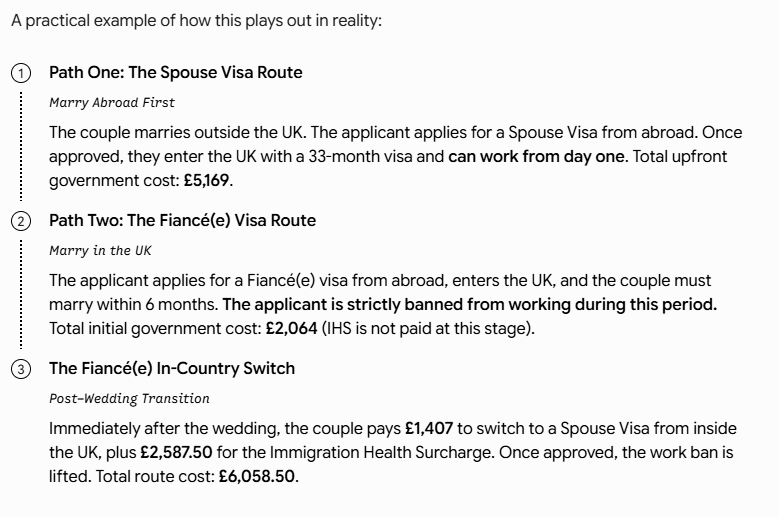
The financial side of this process can catch people off guard, especially following the recent Home Office fee adjustments. Below is a realistic breakdown of the mandatory government fees for marrying abroad (Option 1) or within the UK (Option 2).
| Expense Type | Option 1: Spouse Visa (Marriage Abroad) | Option 2: Fiancé(e) to Spouse Visa (UK Wedding) | Cost Difference |
| Initial Visa Fee | £2,064 | £2,064 | £0 |
| In-Country Switch Fee | £0 | £1,407 | +£1,407 |
| Immigration Health Surcharge (IHS) | £3,105 (33 months) | £2,587.50 (30 months) | -£517.50 |
| Total Mandatory Fees | £5,169 | £6,058.50 | +£889.50 |
The Fine Print: These figures only cover standard Home Office fees. They do not include: Local Wedding Registry Office Costs, Flights, the English language test (~£150), Tuberculosis testing (~£65–£110), Biometric booking fees, or Professional legal representation.
Core Eligibility Criteria For Fiancé(e) Visa
While each situation is distinct and it’s always wise to consult with a UK Immigration Solicitor about your specific circumstances, there are some key criteria that you and your partner must meet to qualify. These guidelines are strict and non-negotiable, so let’s dive into the essential baselines that can help pave your path forward:
- Age and Identity: Both of you must be at least 18 years old and have valid identification.
- The “In-Person” Rule: You must have met in person at least once. No matter how long you have been together online, a purely digital relationship does not count under UK immigration law.
- Freedom to Marry: Both of you must be legally single. If either of you has been married before, you must provide definitive proof, such as a divorce decree absolute or death certificate, to show that you have legally ended the previous relationship.
- Prohibited Degrees: You cannot be closely related by blood in a way that would make marriage illegal under UK law.
Meeting the £29,000 Financial Threshold
The baseline minimum income requirement for a UK fiancé(e) or spouse visa stands firmly at £29,000. Under current rules, this baseline remains the same regardless of how many dependent children are included in the application.If the UK sponsor’s annual salary falls short of £29,000, you aren’t completely out of options. You can bridge the gap using:
- Cash Savings (The 6-Month Rule): If you have no employment income at all and want to rely entirely on savings to meet the requirement, you will need £88,500. This figure is calculated using the strict Home Office formula: (£29,000 \times 2.5) + £16,000. These funds must sit untouched in a regulated bank account for at least six consecutive months immediately before you apply, and you must provide a clear evidence trail of their legal source.
- Combining Salary and Savings: If the sponsor earns less than £29,000, you can use savings to cover the shortfall, provided you have a baseline of more than £16,000. Every £2.50 in savings above that £16,000 mark compensates for £1 of income shortfall. See our income savings calculator.
- Non-Employment Income: Money from property rentals, stocks, dividends, or a pension can be added to your employment earnings.
- The Benefits Concession: If the UK sponsor receives specific state benefits (such as Carer’s Allowance, Disability Living Allowance [DLA], or Personal Independence Payment [PIP]), the £29,000 rule is waived. Instead, you must pass an “adequate maintenance” test to prove you can support yourselves and cover housing without relying on extra public funds. See our maintenance calculator:
Rights, Restrictions, and the “Settlement Clock”
Having a fiancé(e) visa involves notable operational restrictions that often catch many couples off guard:
The Work Ban: While holding a 6-month fiancé(e) visa, applicants are completely barred from working in the UK. This includes temporary jobs, self-employment, and remote work for an employer abroad. Additionally, they cannot access public funds or benefits.
The Settlement Clock: Time spent on a fiancé(e) visa does not count towards the five years required for Indefinite Leave to Remain (ILR). The five-year settlement period only begins once the spouse visa is officially approved after the in-country switch.
Common reasons why Fiancé(e) Visas are refused
The Home Office adopts a meticulous approach when assessing fiancé visa applications, ensuring that all submissions comply with specific evidential requirements. Common reasons for refusals include:
- Insufficient Relationship Evidence: Overemphasis on wedding plans or guest lists without providing a clear, chronological history of regular communication and evidence of time spent together can weaken the application. Strong evidence of the relationship’s authenticity is essential.
- Incorrect English Language Test: Applicants must provide evidence of passing an English language test in speaking and listening at a minimum of level A1 or A2 (as applicable) under the Common European Framework of Reference for Languages. The test must be taken at a Secure English Language Test (SELT) centre approved by the Secretary of State. Tests taken at unapproved centres or those exceeding the two-year validity period at the time of application are not accepted
- Invalid Tuberculosis (TB) Test: TB test results must be obtained from a UKVI-recognised clinic. Tests from unapproved clinics will lead to rejection of the application
- The 28-Day Rule: Financial documents, such as bank statements, must be dated no more than 28 days before the online application submission date. Failure to adhere to this rule can result in refusal.
- Incomplete Financial Evidence: Missing documents, such as a bank statement or an employer letter that lacks required details (e.g., employment type, salary continuity, and contract status), can result in rejection. The financial evidence must comply with the requirements outlined in Appendix FM-SE
- Combining Prohibited Income Categories: Applicants cannot combine cash savings with self-employment income under Categories F or G to meet the financial threshold, as this is not permitted under the Immigration Rules
UK immigration solicitors can assist by meticulously reviewing and preparing the evidence to ensure it meets the Home Office’s requirements. They can help applicants avoid common pitfalls, such as submitting incomplete or inconsistent documentation, which could undermine the application. Solicitors can also liaise with potential witnesses, such as friends or professionals, to draft relevant, corroborated letters supported by documentary evidence. This reduces the risk of the Home Office dismissing such evidence as unreliable.
Planning in key…
The fiancé(e) visa is a great option if having a traditional UK wedding surrounded by family is important to you. However, you must prepare for a two-stage application process, expect higher overall government fees, and anticipate a period of several months during which your arriving partner cannot earn an income. Planning your timing and financial paperwork well in advance is the best way to ensure everything goes smoothly.
Need Clear, Professional Advice?
Applying for a fiancé visa can be challenging, especially when it comes to addressing specific requirements like demonstrating your intention to leave the UK after your visa expires. Skilled UK Immigration solicitor can navigate complex issues, such as previous credibility concerns, by preparing strong applications and providing solid evidence.
By planning carefully and addressing potential pitfalls, applicants can significantly enhance their chances of a successful submission. The support of a knowledgeable UK immigration solicitor can make all the difference in ensuring your application is thorough and well-prepared.
Get Expert UK Immigration Support Today
Feeling overwhelmed by the UK visa application process? At Cross Border Legal Solicitors, we provide personalized guidance to help you navigate it with confidence. Our expert team is dedicated to minimizing your risk of refusal, offering clarity and support for all your immigration and human rights needs. Let’s make your journey smoother together!
Take advantage of our free initial advice to discuss your legal options: Enquire Online: Contact us 24/7 by filling out our Quick Enquiry Form to request a callback at a time that suits you.Call Us Directly: Speak to our specialist legal team during office hours at 0116 380 0744 or 07544 669131
Cross Border Legal Solicitors Ltd is a UK Solicitor law firm regulated by under the Solicitor Regulations Authority. It is Headed by Mr Tito Mbariti, a UK Immigration and Human Rights Solicitor practising lawyer and member of the Law Society of England and Wales.