

The UK immigration landscape is undergoing one of its most radical shifts in recent history. At Cross-Border Legal Solicitors, we are committed to providing clarity and strategic advocacy. This guide outlines the Government’s proposed “Earned Settlement Plan,” introduced in the late 2025 White Paper. These reforms will transform the process from temporary residency to Indefinite Leave to Remain (ILR) and British citizenship.
Understanding ‘Settlement’ and Its Core Advantages
In the United Kingdom immigration framework, “Settlement” refers natively to acquiring Indefinite Leave to Remain (ILR). This status allows unrestricted residency without the need to meet strict visa requirements like specific employment or family relationship benchmarks. Securing ILR delivers profound economic, financial, and civil advantages:
- Full Right to Work: Complete removal of sponsor ties or visa caps for skilled workers, granting full professional flexibility.
- Recourse to Public Funds: Immediate eligibility for state support structures, which includes Universal Credit, Child Benefit, and local authority housing assistance.
- Immigration Health Surcharge (IHS) Exemption: Eliminates the costly annual burden (£1,035 per adult / £776 per minor) required during limited leave extensions.
- Higher Education Equality: Unlocks “Home Fees” status and standard student loan access, provided the applicant has been ordinarily resident for the previous three years.
- Direct Path to British Citizenship: Serves as the mandatory prerequisite for adult naturalisation or immediate registration of children born in the UK.
The 2025–2026 Political Context: How We Got Here
The current proposals emerged from intense multi-party competition throughout 2025. Between February and May 2025, the Conservative Party introduced an Immigration and Visas Bill (‘Deportation Bill’). This bill sought a sweeping 10-year minimum baseline to ILR for workers and partners. This was followed by a Reform Party announcement in September 2025; consequently, it pushed to abolish ILR altogether.
In response, the current Government published its definitive consultation framework, “A Fairer Pathway to Settlement,” on November 20, 2025. The Government is implementing structural changes after a public consultation that ended on February 12, 2026. This includes raising the English language benchmark from B1 to B2, effective March 2027.
The Proposed “Earned Settlement” Architecture
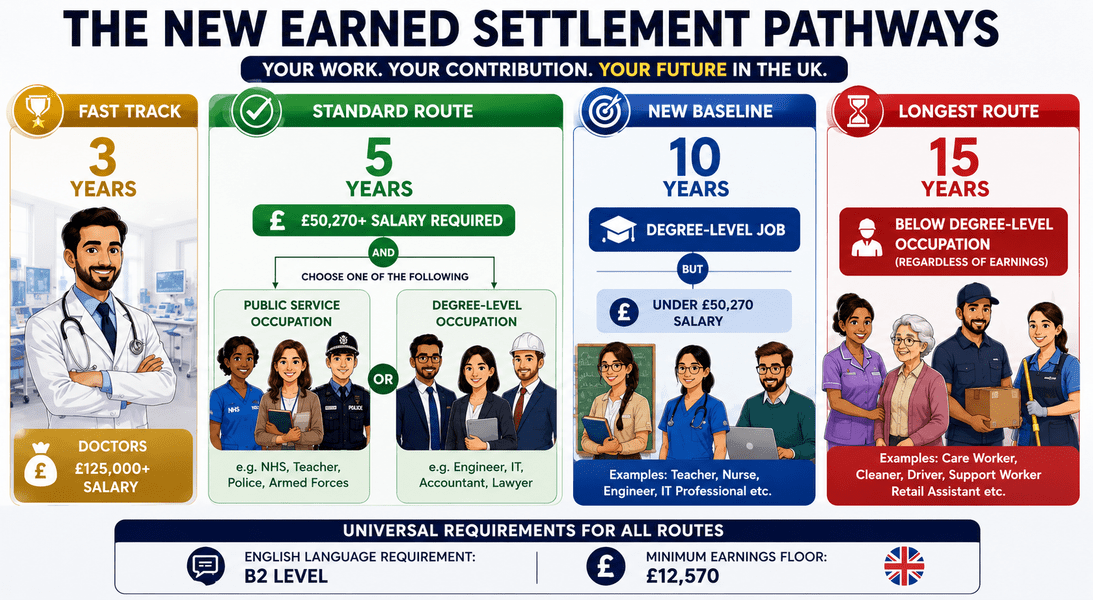
The new model establishes a restrictive, multi-tiered framework that shifts to an “earned” compliance and economic metric system.
⚠️ Critical Update: Mandatory Universal Baselines
Regardless of your specific visa category, the new framework introduces two strict universal pillars:
- English Language: Elevation from CEFR Level B1 to B2 (effective March 2027).
- Minimum Earnings Threshold: A strict new mandatory baseline floor of £12,570 per annum to qualify for settlement.
Tiered Residence Requirements for Skilled Workers
The traditional, straightforward 5-year route to settlement is being replaced by an economically stratified system for main applicants:
- 3-Year Route: High-earners consistently generating £125,000+ per annum for the previous 3 years.
- 5-Year Route: Occupation at or above degree level AND either earning £50,270+ for the previous 3 years OR working within designated public service occupations.
- 10-Year Route: Occupation at or above degree level but earning less than £50,270 per annum. This forms the new baseline.
- 15-Year Route: Any occupation classified below degree level, regardless of total annual earnings.
Impact on Families, Partners, and Dependents
The proposed rules pose significant challenges for family reunification and dependents. The details are not yet fully available, and for now, we can only speculate and make educated guesses based on what various people in the government have said to the press or in parliamentary discussions. Among the hundreds of anticipated changes are:
- Partners & Spouses: Only family members of British citizens retain a 5-year settlement pathway. Partners of ILR holders or skilled workers will default to a 10-year baseline and must independently satisfy the £12,570 mandatory minimum earnings requirement, creating an acute barrier for non-working spouses.
- Children and Adult Dependents: Due to longer qualifying periods, more dependent children will reach age 18 before their parents become eligible for settlement. At 18, they will struggle to meet the mandatory £12,570 earnings requirement independently, forcing the Home Office to develop separate transition rules.
Proactive Next Steps: Protect Your Immigration Status
With final legislative texts expected between September and October 2026, waiting is not an option. If you currently meet the criteria for ILR or British Citizenship under the current rules, you should file your applications immediately to protect your continuous residence.
Expert Legal Assistance: Contact Tito Mbariti and the specialist team at Cross-Border Legal Solicitors today to audit your visa pathway, secure your residency documentation, and navigate these complex shifts.
If you need tailored guidance on your UK visa application or want to minimise the risk of a refusal, Cross Border Legal Solicitors is here to help. We provide expert clarity and dedicated support for all UK immigration and human rights matters.
Take advantage of our free initial advice to discuss your legal options: Enquire Online: Contact us 24/7 by filling out our Quick Enquiry Form to request a callback at a time that suits you. Call Us Directly: Speak to our specialist legal team during office hours at 0116 380 0744 or 07544 669131
Cross Border Legal Solicitors Ltd is a UK Solicitor law firm regulated by the Solicitors Regulation Authority. It is headed by Mr Tito Mbariti, a UK Immigration and Human Rights Solicitor, practising lawyer and member of the Law Society of England and Wales.