

One of the most persistent and damaging misconceptions in UK immigration law is that the “7-year child rule” exclusively protects children who were born on British soil. Families frequently assume that if a child was born overseas, they cannot use their length of residence to regularise their stay or protect their parents from deportation.
The legal reality is much more reassuring: the 7-year child rule absolutely applies to children born outside the UK. Under Appendix Private Life of the Immigration Rules, any eligible child who has spent a continuous seven-year period living in the country can apply to regularise their status, unlocking a pathway for their parents to do the same.
However, the rules treat UK-born and foreign-born children differently in one critical aspect: the speed at which they achieve permanent settlement.
What is the 7-Year Child Rule? Legal Foundation
The 7-year child rule applies to children who have resided in the UK for at least seven continuous years, regardless of whether they were born in the UK or abroad.
This is explicitly supported by the Immigration Rules under Appendix Private Life, which provides that children born in the UK or those who have lived in the UK for seven years may qualify for settlement if it is demonstrated that it would be unreasonable to expect them to leave the UK.
Historically, this framework replaced the pre-July 2012 ‘seven-year child concession’ policy. Today, it serves as a formalised legal route allowing children under the age of 18 to apply for leave to remain and ultimately regularise their family unit’s long-term stay provided they hit the continuous residency milestone and satisfy the Home Office’s strict criteria.
The Core Requirements: Who Qualifies?
To make a successful application anchored on a child’s 7-year residence, the child must meet three primary criteria on the date the application is submitted:
- Age: The child must be under 18.
- Continuous Residence: The child must have lived in the UK continuously for at least 7 years. Crucially, this residence counts whether it was entirely lawful, entirely unlawful, or a mix of both.
- The Reasonableness Test: It must be established that it would not be “reasonable” to expect the child to leave the UK.
⚠️ Crucial Note on Continuity: “Continuous residence” means the child must not have been absent from the UK for more than 6 months at any one time, and must not have spent a cumulative total of more than 18 months outside the UK during those 7 years.
The Big Difference: Path to Settlement (ILR)
While both UK-born and foreign-born children can secure status under this route, their final destinations look very different. The Immigration Rules explicitly reward UK birth with a significantly faster route to Indefinite Leave to Remain (ILR).
| Application Aspect | Child Born in the UK | Child Born Abroad |
| Initial Grant | Immediate Settlement (ILR) | Permission to Stay (Temporary Visa) |
| Time to ILR | Instant (0 Years) | 5 Years (Under the 5-year Private Life route) |
| Application Fee | Standard ILR fees apply | Standard Leave to Remain fees (Fee waivers available) |
As you can see on the table above, if a child born abroad reaches 7 years of residence in the UK, they enter a compressed 5-year route to permanent settlement. Paragraph PL 10.1 of the Immigration Rules gives these young applicants a distinct advantage when choosing how to structure their stay. They can apply for either a 30-month or a 60-month block of permission.
While opting for 30 months means preparing a renewal application halfway through the process, choosing the 60-month period covers the entire 5-year pathway to Indefinite Leave to Remain (ILR) in a single grant, avoiding extra fees and paperwork down the line.
The Ultimate Advantage: Children Born in the UK
While children born abroad must wait out a 5-year pathway to settlement after hitting their 7-year residency milestone, the rules are completely different for children born on British soil.
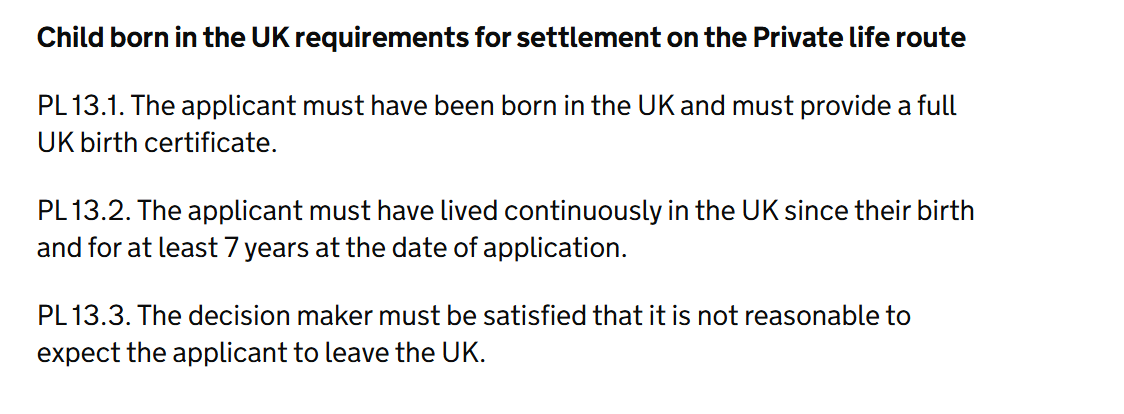
Under paragraphs UK Immingration Rules ( Appendix Private Life), a child born in the UK who has lived here continuously for their first 7 years can bypass the temporary visa stages entirely. They are eligible to apply for immediate settlement (Indefinite Leave to Remain), provided they can supply a full UK birth certificate and establish that it is unreasonable to expect them to leave the UK. Furthermore, skipping the probationary visa wait entirely doesn’t just fast-track their permanent residency; it also means that once they reach the age of 10, they become eligible to register as a British citizen.
How the Parents Can Regularise Their Stay
Once a child satisfies the 7-year threshold, they become a “qualifying child” under immigration law. This is the legal mechanism that allows parents to regularise their own status.
Parents can apply for Leave to Remain under Appendix FM (Family Life as a Parent) if they can demonstrate they have sole or shared parental responsibility for the child, and that they play an active role in the child’s upbringing.
💡 The Parental Settlement Timeline
Unlike their foreign-born children (who get a 5-year route to settlement), parents regularising their stay via this method are almost universally placed on a 10-year route to settlement. This means the parents must renew their visa every 2.5 years (30 months) for a decade before they can apply for ILR.
Ten (who get a 5-year route to settlement), parents regularising their stay via this method are almost universally placed on a 10-year route to settlement. This means the parents must renew their visa every 2.5 years (30 months) for a decade before they can apply for ILR.
The Ultimate Battleground: The “Reasonableness” Test
Meeting the 7-year timeline is a matter of mathematical fact, easily proven with school letters, medical records, and bank statements. The true legal hurdle is satisfying the Home Office that it would be unreasonable to expect the child to leave the UK.
The reasonableness test is a critical factor in determining eligibility. The legal starting point is that it is generally not reasonable to expect a qualifying child to leave the UK. Factors considered during this evaluation include the child’s age, their established ties to the UK, key relationships, and any previous visits to the country of return.
Crucially, the best interests of the child are paramount throughout this assessment, and it is normally in the child’s best interests for the family unit to remain together.
Despite this protective starting point, Home Office caseworkers heavily scrutinise family applications where the parents have no valid status. Following complex legal precedents, decision-makers often seek to argue that if the parents must leave the UK, it remains reasonable for a foreign-born child to return to their country of origin with their parents as a complete family unit.
To firmly tilt the scale and satisfy the requirements, applications must be backed by heavy, robust evidence showing the child’s deep integration into UK life. Key factors include:
- Educational Milestones: Critical schooling years (e.g., preparation for GCSEs or key primary school stages).
- Social and Cultural Ties: Active participation in community groups, sports clubs, and strong networks of friends.
- Language and Health: Instances where the child speaks only English and has little to no linguistic or cultural connection to the parents’ country of birth, or relies on the NHS for complex medical conditions.
Conclusion & Next Steps
If your child was born abroad but has lived continuously in the UK for 7 years, they have a legal right to seek status, and you, as a parent, have a pathway to legal residency. Do not let the fact that they were born overseas deter you. Because the Home Office sets a remarkably high bar for the “reasonableness test,” compiling a meticulously documented, evidence-led application is crucial to securing a positive outcome for your family.
Get Expert UK Immigration Support Today

If you need tailored guidance on your UK visa application or want to minimise the risk of a refusal, Cross Border Legal Solicitors is here to help. We provide expert clarity and dedicated support for all UK immigration and human rights matters.
Take advantage of our free initial advice to discuss your legal options: Enquire Online: Contact us 24/7 by filling out our Quick Enquiry Form to request a callback at a time that suits you. Call Us Directly: Speak to our specialist legal team during office hours at 0116 380 0744 or 07544 669131
Cross Border Legal Solicitors Ltd is a UK Solicitor law firm regulated by the Solicitors Regulation Authority. It is Headed by Mr Tito Mbariti, a UK Immigration and Human Rights Solicitor practising lawyer and member of the Law Society of England and Wales.