

We first wrote about this in 2013. More than a decade on, it’s still one of the most important things to understand before you pay anyone for immigration help. “UK Immigration Solicitor“, “UK Immigration Lawyer” and “UK Immigration adviser” are not interchangeable. The difference decides how well your case is handled and what protection you have if it goes wrong, and sometimes whether the person helping you is even acting lawfully.
Why does this matter?
Because we still see what happens when people get it wrong.
We once met a man who’d paid around £10,000 to people he believed were solicitors to extend his family’s leave. The application never reached the Home Office. By the time he came to us, the office had closed, the people had vanished, and he was trying to trace his passport while facing removal. He’d paid in cash, with no receipts.
Before you pay anyone, know exactly who is handling your case and what recourse you have if it fails.
Is it actually illegal for an unregulated person to give immigration advice?
Yes. This is the most important point in this article.
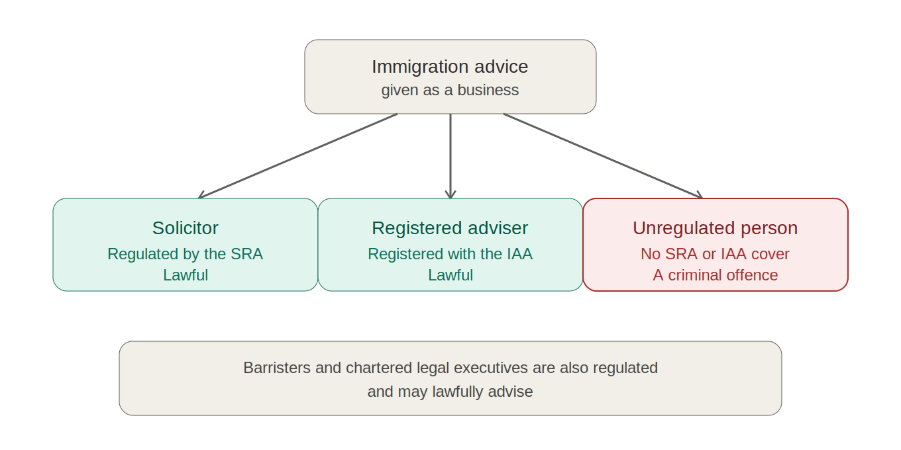
Immigration advice is a regulated activity. It is a criminal offence to provide immigration advice or services without authorisation, whether or not the business is run for profit, under Section 91 of the Immigration and Asylum Act 1999. A ‘free’ service run by an unregulated person can still be unlawful.
Only two broad groups can lawfully advise you:
- People regulated by the Immigration Advice Authority (IAA): registered immigration advisers.
- People regulated by an approved professional body: most importantly solicitors (regulated by the SRA), plus barristers and chartered legal executives. This includes Cross Border Legal Solicitors.
What is the IAA, and what happened to the OISC?
On 16 January 2025, the OISC (the Office of the Immigration Services Commissioner) was renamed the Immigration Advice Authority (IAA). Despite the name change, this body remains the regulator for immigration advisers who are not solicitors or barristers. Existing registrations remained valid through the change, so if you see older articles or adverts still referring to “OISC registered”, that now means IAA registered.
The IAA registers and supervises immigration advisers, audits organisations, and investigates and prosecutes people who give immigration advice illegally or to a poor standard. It now places real emphasis on enforcement against unregulated advisers, which is good news for the public.
What’s the difference between a lawyer, a solicitor and an adviser?
Lawyer
‘Lawyer’ is a broad, general word for someone who is learned in the law. If you have a law degree, you can loosely be called a lawyer. It is the starting point, not a qualification to practise.
Becoming a ‘lawyer’ means a law degree, or a degree in another subject followed by a law conversion course. Importantly, a degree alone does not by itself authorise one to give immigration advice or run a case.
Solicitor
A solicitor is a qualified, regulated legal professional who has trained well beyond a university degree. At least six years studying and carrying out supervised practice is required before becoming qualified.
Once qualified, a solicitor is bound by a strict code of conduct and must work within a firm regulated by the Solicitors Regulation Authority (SRA). That firm has to carry professional indemnity insurance and run a formal complaints procedure. If something goes wrong there’s a clear route to a remedy: complain to the firm, escalate to the Legal Ombudsman, or report misconduct to the SRA. A solicitor who acts dishonestly risks being removed as a solicitor and losing their career.
Many immigration solicitors also hold specialist accreditation, given how technical this area of law can be.
Immigration adviser (IAA registered)
An immigration adviser is someone registered with the IAA to give immigration advice without being a solicitor or barrister.
The route to becoming a registered adviser is far shorter than qualifying as a solicitor. A person can complete the registration process in a matter of weeks rather than years. This includes a competence assessment and background checks. Advisers are registered at different levels. Level 1 is the most basic, with higher levels permitting more complex work, including representation in court.
Are immigration advisers a bad choice?
No, and it is important to be fair here. Not all immigration advisers are poor at their job. Many IAA-registered advisers are competent, ethical and good value. Some hold law degrees or even legal qualifications. Some are non-practising solicitors who choose to work under IAA regulation because the insurance and regulatory costs are lower. A good, experienced, higher-level adviser can handle their cases well.
You should know who you are dealing with and choose appropriately for the complexity and stakes of your case.
How do I decide who I need?
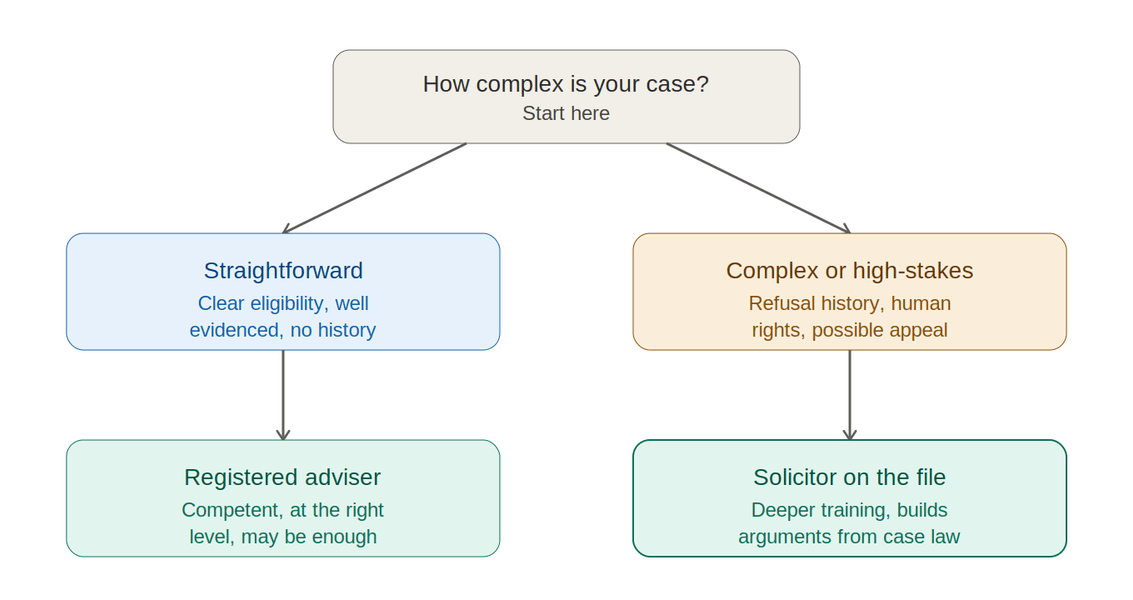
For a straightforward, well-evidenced application, a competent, registered adviser at an appropriate level for your case may be perfectly adequate.
For anything complex, high-stakes or where things could go wrong, a solicitor’s detailed legal training matters. Examples include clearly not meeting financial requirements, a history of refusal, where human rights or “outside the rules” arguments are needed, or where an appeal or judicial review may follow. Solicitors are trained in legal research and advocacy and can build arguments using their experience to support a difficult application.
The reasoning is simple. If someone were tempted to take a risk with your money or your case, who has more to lose: the person who spent six years earning a licence that can be taken away, or someone who obtained the right to advise within a few weeks?
A simple analogy: Think of building work. A civil engineer designs the structure and supervises the trades who carry it out. A skilled handyman can fix a great many things around a house, and you would happily have them do so. But if you were building a house from scratch, or carrying out major structural work, you would want the qualified engineer in charge. You would be glad to have the handyman do the work under the engineer’s direction.
It is the same with your immigration matter. Match the level of expertise to the seriousness of the job.
How do I check if someone is who they claim to be?
This takes two minutes and can save you thousands of pounds and untold stress.
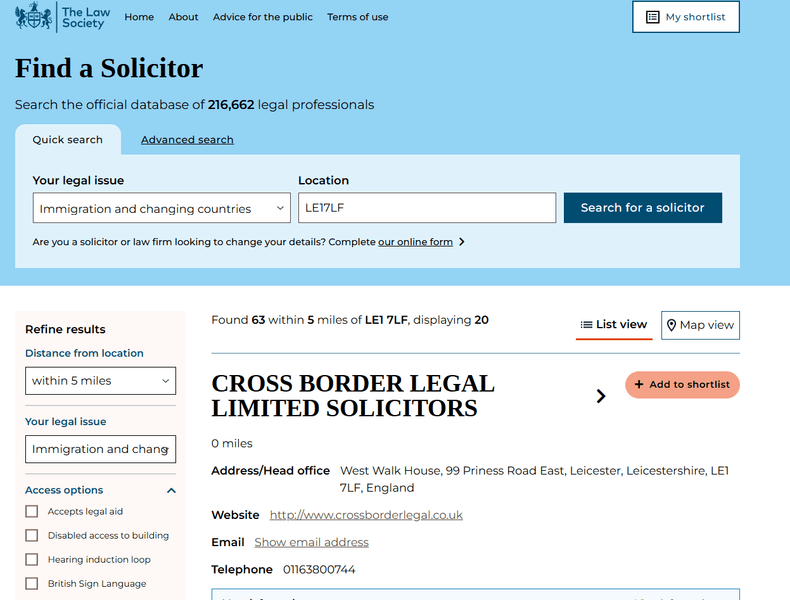
- To check a solicitor or solicitors’ firm, use the Law Society’s “Find a Solicitor” service and the SRA’s register.
- To check an immigration adviser, search the Immigration Advice Authority’s register of regulated advisers.
If the person cannot be found on either, you may want to ask directly: are you a solicitor, or are you IAA registered, and at what level? A legitimate professional will answer happily and will confirm their advice and fees in writing.
What should I expect from a properly regulated professional?
Among other things:
- Clear information about fees from the outset.
- Advice confirmed in writing, not just verbally.
- Regular updates on the progress of your case, without you having to chase for months.
- A formal complaints procedure, insurance, and a regulator standing behind them if something goes wrong.
If you are being asked for large cash sums with no receipts, given vague promises, or kept in the dark about who is actually handling your file, stop and reconsider.
Before you pay anyone
The next time you seek help with an immigration matter, ask one simple question before you pay anyone: who exactly is dealing with my case, and are they regulated to do it?
As the saying goes, you get what you pay for. Knowing the difference between a solicitor, a lawyer and an adviser is the first and most important step in protecting yourself.
If you have been affected by any UK immigration matter, please contact solicitor Tito Mbariti, a UK immigration and human rights solicitor, for free initial advice about your legal options.
You may contact us by filling out our Quick Enquiry Form any time you need professional support or have any questions. Alternatively, you can call us during office hours on 07544669131 / 0116 3800 744.
Cross Border Legal Solicitors Ltd is a UK Solicitor law firm regulated by the Solicitors Regulation Authority. It is headed by Mr Tito Mbariti, a UK Immigration and Human Rights Solicitor, practising lawyer and member of the Law Society of England and Wales.