
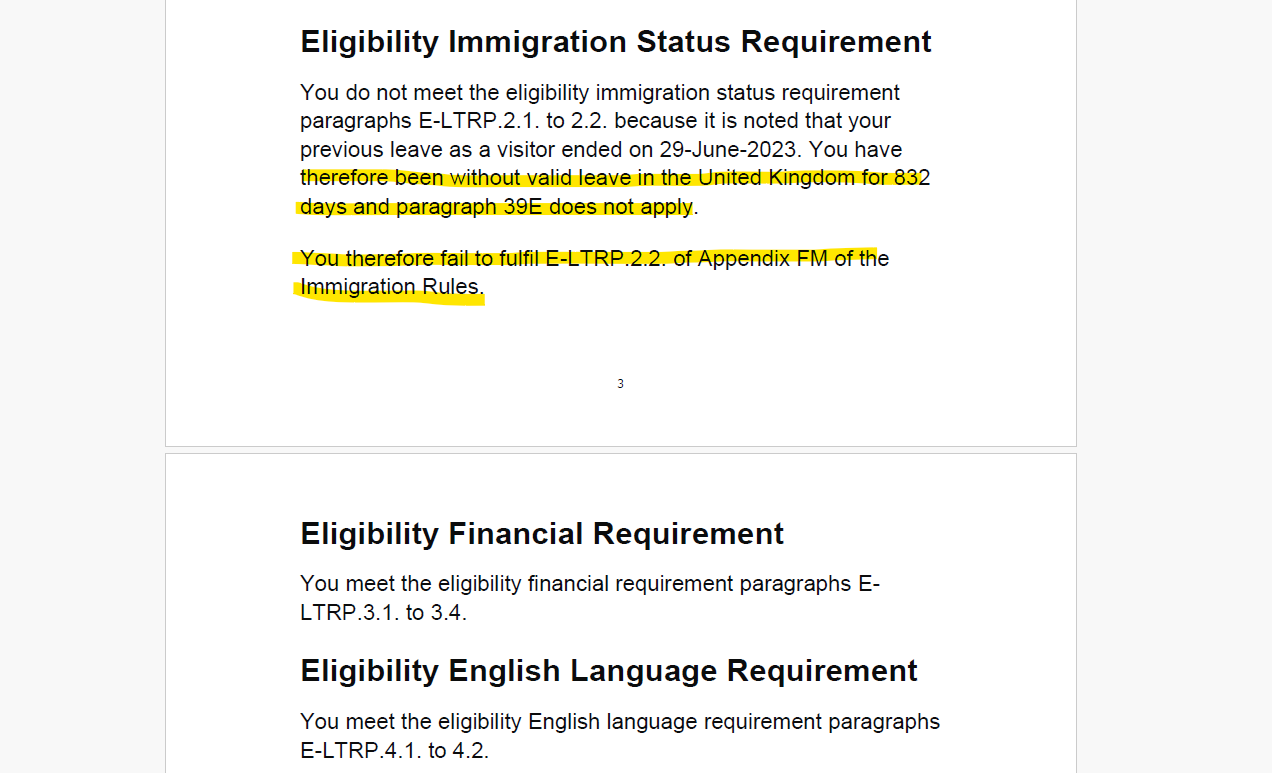
If you or your partner has previously overstayed in the UK and is now seeking a spouse visa, it is important to understand that the rules have changed and the process has become more complex. The legal framework governing refusals has tightened, meaning applications that might previously have been considered a realistic route can now face much stricter scrutiny, particularly where there is a history of overstaying, even in the absence of deception or criminal conduct.
The Home Office has introduced a consolidated suitability framework into the Immigration Rules: Part Suitability, which applies to most visa categories, including family and spouse visas. This guidance was officially brought into force on 11 November 2025 and explained in detail in the December 2025 guidance for caseworkers.
How the Rules Have Changed
Before 11 November 2025, spouse visa applications involving overstaying were considered under the older Part 9 – General Grounds for Refusal framework of the Immigration Rules, where family-based routes had some degree of flexibility in suitability assessments. Specifically, while other applications would face a temporary ban ( between 12 months and 10 years) for previous immigration breaches such as deception or overstaying your visa, family visas were exempted from this automatic ban.
From 11 November 2025, the Home Office replaced Part 9 with a new consolidated Part Suitability framework, which applies across most visa categories, including the family and spouse visa routes such as Appendix FM( Spouse visa, Fiancée/e and Parent Visa). Under Part Suitability, suitability grounds, including immigration history, are now uniformly assessed rather than being treated more leniently for family-based cases.
The published Home Office guidance on “Part Suitability: previous breach of UK immigration laws” confirms that overstaying, unless an exception applies, is a defined breach of immigration law and may be a ground for refusal of entry clearance or permission to enter. A previous overstay is treated as a breach if the applicant was aged 18 or over, unless the overstay qualifies under very limited exceptions.
- Short overstays may be disregarded: for overstays after 6 April 2017, 30 days or less are generally not considered a breach, and for overstays before 6 April 2017, 90 days or less may be ignored.
- Another exception applies if the overstay happened because of a Home Office decision that was later withdrawn, quashed, or ordered to be reconsidered by a court or tribunal, provided the legal challenge was made promptly.
Outside of these narrow situations, overstaying is counted as a breach, and mandatory refusal periods (re-entry bans) usually apply, starting at 12 months for voluntary departure at the applicant’s own expense, and longer in more serious cases. (gov.uk guidance)
This change has removed much of the flexibility previously available to family route applicants. Even where a relationship is genuine, and all financial and accommodation requirements are met, a history of overstaying now carries a significant risk of refusal.
Historic overstaying is now front and centre in immigration history assessments for spouse visas.
Family Visa Appeals: Adult-Only Cases Are More Challenging to Access Merit
In straightforward family visa in-country appeals where there are no children or exceptional circumstances such as serious illness, the Home Office’s current enforcement of Part Suitability means that historic overstaying will almost always be raised as a key issue.
The Home Office’s long standing position, in opposing an appeal in the tribunal court for refusal of an overstayer or a person on a visit visa, to switch to a leave to remain in the UK, has been such visa should not be granted as such couple had an option of applying entry clearance that separation while applying from abroad is a reasonable and proportionate alternative to continued unlawful residence. Historically, this was easier to argue because out-of-country applications often took only a few weeks, so separation was short. Today, mandatory refusal periods (for example, a 12-month re-entry ban after overstaying and voluntary return at one’s own expense) create a separation that can stretch far longer, raising genuine proportionality questions under Article 8 of the European Convention on Human Rights.
While the Home Office can still argue that leaving the UK and applying from abroad is reasonable, courts and tribunals are increasingly being asked to grapple with whether a year‑plus separation is still proportionate when weighed against genuine family life, a core issue in Article 8 appeals.
What Part Suitability Really Means
Under the new Part Suitability rules, the Home Office has a statutory basis to refuse an application if the candidate has “previously breached immigration laws.” This includes overstaying without a recognised exception, as defined in paragraph SUI 11 of the Immigration Rules. Overstaying — unless it falls within very narrow exceptions — is treated as a breach punishable by refusal even in family visa cases. (GOV.UK)
For example, the Immigration Rules state that an application must be refused if:
- The applicant previously breached immigration laws (including overstaying), and
- The new application is made within the relevant mandatory refusal period (e.g., 12 months). (GOV.UK)
This means that historic breaches are no longer something that can be easily overlooked in a spouse visa application, even if all other requirements are met.
Mandatory Refusal Periods (Re‑Entry Bans)
Where a previous breach is established — for example, by a period of overstaying — the applicant may be subject to a mandatory refusal period. The length of this period depends on how and when the person left the UK. For example:
- 12 months if the person left voluntarily at their own expense
- 2–5 years if they left at public expense
- 10 years if removed or where deception was involved (GOV.UK)
This is now an explicit part of the UK visa suitability regime and can apply to family route applications just as it does for work or student visas.
What This Means for Spouse Visa Applicants
Even where a relationship is genuine and all other requirements (such as financial, accommodation, and English language criteria) are met, having a history of overstaying now carries significant added risk. A straightforward spouse visa application is no longer just about satisfying the rules; it’s about managing suitability considerations under the Part Suitability regime.
In many cases, experienced immigration lawyers recommend adopting a careful legal strategy before applying, which may include considering voluntary departure and applying from abroad where appropriate, as well as preparing for the possibility of an appeal, particularly where a refusal could lead to a lengthy period of separation. Each option carries its own implications and risks, making tailored legal advice based on the applicant’s specific circumstances essential.
Why Taking Immigration Advice Can Be Important
These are no longer straightforward visa applications. With Part Suitability now in force, issues such as previous immigration breaches, particularly overstaying, play a much more central role in how decisions are made. Understanding the relevant Immigration Rules and Home Office guidance, including the provisions on suitability and mandatory refusal periods, can therefore be important when deciding how and when to apply, and in avoiding mistakes that may lead to refusal.
At Cross Border Legal Solicitors, we specialise in UK spouse visas, complex immigration histories, and Article 8 appeals. We routinely advise clients from African, Asian, and diaspora backgrounds, helping them navigate these changes and make decisions that maximise their prospects of success.l framework and give you clear, practical guidance on the right path forward.
You may contact us by filling out our Quick Enquiry form whenever you need professional support or have questions about your UK Immigration. Alternatively, you can call us during office hours on 07544669131 / 0116 3800 744
Cross Border Legal Solicitors Ltd is a UK Solicitor law firm regulated by under the Solicitor Regulations Authority. It is Headed by Mr Tito Mbariti, a UK Immigration and Human Rights Solicitor practising lawyer and member of the Law Society of England and Wales.